The Final Act: Austin's Bond Election Proposal Heads to Council
On May 4, the Bond Election Advisory Task Force (BEATF) wrapped up its final meeting — nearly 18 months of work identifying Austin's most pressing capital improvement needs. Their recommendations now move to city staff, who will develop a final proposal for Austin City Council. Council is expected to vote later this month on whether to call a bond election in November.
Here’s the latest:
Setting the Scene:
The BEATF was created in December 2024 to identify capital improvement priorities and recommend a bond package—including a directive to assess community input projects and alternative funding mechanisms. It was organized into five working groups covering affordable housing, public facilities, parkland and open spaces, stormwater and drainage, and transportation. Once the needs began to take shape, the task force began working toward a recommendation in the $700–750 million range.
The Plot Twist:
On April 20, a subquorum of five City Council members stepped up with an alternative script: a smaller package of $375-$400 million that would focus on parks, active transportation and community facilities projects. The context matters here. Austin voters rejected Proposition Q last fall, and the Council members who proposed the alternative were thinking carefully about what voters are likely to support — a fiscally conservative package that still addresses critical needs, at, according to Council Member Alter’s office, a cost of less than $5 per month to the average taxpayer. It's a smart read of the room, and we appreciate that they kept parks funding strong in their scenario.
Two Recommendations, One “Strong Preference”
When the final vote came, the task force did something straightforward: they put both options on the record. The primary recommendation — a $766.5 million comprehensive package — passed unanimously, with the task force expressing a strong preference for this option. Members acknowledge it exceeds current bonding capacity and expects Council to adjust the number as needed, but they wanted their priorities on the record.
The secondary recommendation — a $436 million package developed in direct response to the subquorum's request — also passed, but with less support. The task force noted explicitly that the exclusion of affordable housing and stormwater funding were the primary reasons they did not favor the smaller amount.
The smaller secondary recommendation includes $225 million for parks and open spaces, $95 million for public facilities and assets, and $80 million for transportation and electrification — and by providing more generous parks funding, it is the scenario that best positions Zilker Park projects for funding.
The task force also approved a number of policy recommendations alongside the financial packages for consideration by Council.
Why the Parks Number Is the One to Watch
This is the part we really want people to understand. The Parks and Recreation Board passed a resolution 10-0 on April 27 laying out the situation with clarity: the 2018 bond — the last dedicated parks proposition — has been substantially spent. APR has only modest contingency reserves left. The department received nothing from the 2016 or 2020 transportation bonds, and nothing from the 2022 housing bond. Meanwhile, the department has identified roughly $1.4 billion in capital needs citywide.
The Parks Board's message to Council was straightforward: $250 million is the floor for meaningful investment — the level at which APR can move beyond patching emergencies and actually deliver improvements Austinites can see and use, across pools, recreation centers, trails, senior facilities, and parkland. Task Force Chair, Mary Hager, put it plainly: Austin is "developing gray space a lot faster than green space." Parks has been waiting in the wings long enough.
What Zilker 351 Asked For
At the BEATF meeting, we made the case for both the smaller bond package and four specific Zilker Park projects. We support the subquorum's smaller bond package scenario because it keeps parks funding at $225–250 million — in line with what the Parks Board is calling for — while also investing in active transportation and community facilities. For Zilker Park, this is the package with the best chance of putting real wins on the board.
The four Zilker projects we have been advocating for are:
- Barton Creek Shoreline Restoration ($3 million from the Parks allocation)—protecting the safety and health of every person and pup who swim at Barking Springs.
- Zilker Loop Trail Footbridge ($7 million from Active Transportation allocation)—closing the gap in safe, car-free connectivity through the heart of the park.
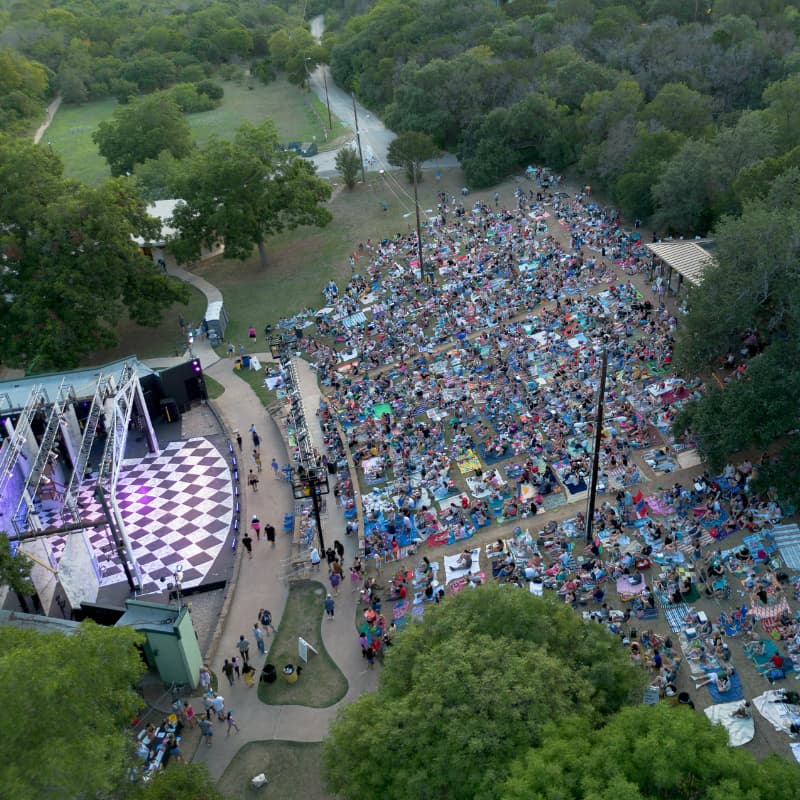
- Hillside Theatre Reconstruction ($5 million from Community Facilities)— restoring a free, beloved community gathering place that has served generations of Austinites.
- Woodland Tree Canopy Expansion ($2 million from Parks allocation)— building ecological resilience through native tree planting for aquifer infiltration and climate resilience.
What Comes Next
City staff will now take the task force's recommendations and develop a final proposal. Council is expected to decide whether to call the bond election by the end of May. We'll be watching, engaging, and keeping you informed every step of the way. If you want to make your voice heard directly, public comment opportunities at Council are coming — we'll share details as they're announced.
The show isn't over yet. In fact, it's just getting interesting.